Thursday, December 12, 2019

To Die or Not to Die...

The reason we fear spiritual maturation and self-actualization is actually the same biological reason we inherently fear snakes. 

Though we may think that a fear of snakes is solely a cultural conditioning, which it can be, there are fascinating studies that point to our fear of snakes as a critical component of human evolution. One study was conducted where infants between six and twelve months of age, who had never encountered a snake or spider, either in real life or pictorially, were exposed to a series of slides. There were images of trees, and rocks, and flowers, and other insects, yet whenever a slide of a snake or a spider was shown, there was a distinct dilation of the pupils in each of the infants, that didn’t occur in response to any of the other slides. This pupil dilation is a direct response to the Parasympathetic Nervous System being activated, or in other words, the "fight, flight, or flee" trigger. 

How could it be that infants, with no previous cultural conditioning, were afraid of snakes? Epigenetics certainly comes into play, as we now know that phobias and emotional trauma can be passed down through the generations in our DNA. So it’s reasonable that if Grandma Gina was terrified of snakes, that her decedents may carry shades of that terror. 

But other research supports the idea that this fear of snakes goes much further back than Grandma Gina, that it’s actually in the human gene, because if it wasn’t perhaps we would not be alive to even have this conversation. It’s our fear of snakes, as part of the greater drive for self-preservation, that kept our species on the winning side of natural selection. This is why our eyes are forward-facing, and why we’re adept at tree climbing, to mention two examples of how we’ve stayed one step ahead of our venomous predators. 

So we fear snakes because we don’t want to die. Evolutionarily, that fear of death and instinctive self-preservation has kept us alive and allowed us the most advancements as a species--but only physically

Because we don't exactly know what happens after we die, most of us tend to delay finding out as long as possible. I'm a big fan of being alive. That also means I’m a big fan of self-preservation. But the catch is that it’s not just our genetics that are fighting desperately to stay alive—so does our ego. In fact, maybe the ego is a direct result or natural byproduct of physical evolution. As our brains grew bigger and our genes grew more durable, we suddenly had the luxury of philosophical thought, because we weren’t fighting endlessly for each daily meal. We learned how to subsist, which freed up space in our mental capacity for existential reaching: Who am I? Why am I here? Where am I going after I die? 

And along with that existential reaching, came it’s wicked step sisterexistential answers. The idea that we can answer these questions is egotistical. How so? Because the ego thrives on false identities and the stories we tell ourselves. Were we ever supposed to be able to answer them? Are we kidding ourselves when we think we have? 

When we attempt to answer these important questions, instead of respecting them as questions, we create a persona, an alternate reality, an egoic state. And that egoic state learns to fight as vehemently for life as our own genetics. We love to live behind the illusion of who we think we are, why we’re here, and where we’re going. This is the heart of religious struggle and warfare, cultural division, racism, and elitist thinking. On a personal level, it’s the heart of mental illness, where reality is fractured and we no longer live on the same plane as those around us. 

Letting go of the egoic illusion is the way we experience spiritual maturation and self-actualization. 

What is critical for our long-term physical survival—the fear of death—is the antithesis for our spiritual survival. We are a living paradox, asked to self-preserve in our biological make-up, and simultaneously asked to die egoiclly over and over again. Eve’s fall was the metaphorical egoic death. Christ’s crucifixion and the narrative of the atonement was the metaphorical egoic death. That’s what every spiritual guru and book of scripture is actually pointing to. 

Our task is immense. We have to overcome our own inherent biological drive to stay alive and willingly die in order to spiritually come alive.

In biology class you learned that evolution is the process by which different kinds of living organism are believed to have developed from earlier forms during the history of the earth. Darwin espoused, quite convincingly, that this is made possible through the process of Natural Selection. When three key components are in place, evolution occurs:
  1. Variation
  2. Differential Reproduction
  3. Heredity
Take an example of beetles, where some are bright green and others are dark brown (variation). Birds swoop down and gobble up the bright green beetles because they’re so easily spotted along the dirt floor, which creates an imbalance in numbers (differential reproduction). This means the brown beetle population is now outnumbering the green beetle population, and therefore producing more brown beetle babies (heredity). And just like that, certain species go extinct while others continue to evolve. Eventually, certain desirable traits that promote survival continue to get passed along, while less favorable traits (such as bright green beetle pigmentation) get nixed (unless you’re a jungle beetle where green becomes the camouflage and brown is so yesterday).

But what does this look like on the spiritual plane? Is natural selection still happening where spiritual evolution is concerned? In physical natural selection, we’re talking about various organisms—the first key component. But in spiritual evolution, those various organisms are housed in the same host: you, me, and all of us. You have within you the green beetle of narcissism coexisting with the brown beetle of empathy. Which one will win? Which beetle (or more poetically, which wolf) will you feed? Both are vying for life, after all.

In this regard, spiritual evolution is a harder undertaking because we actually have to choose it. We have to instigate it. We have to allow it. This is not the case for physical evolution. We could hardly prevent it even if we tried. It’s an incredibly slow moving ordeal that takes eons of time to carry out, which is why we will never complete the human taxonomy charts. The branches of extinct species that had to have occurred in order for the modern homo sapien sapien to even be what it is today is beyond measure, and would likely require a terrific algorithm to represent. Incalculable species died in order for us to be alive, and we have been millions of years in the making. 

Is spiritual evolution just as tediously slow? Yes, and no. Yes, because spiritual evolution is inseparably linked to physical evolution. In other words, it’s only possible because of the other, as we mentioned before--existential outreaching is a luxury. So in all reality, our millions of years of physical evolution has been leading us to the potential of spiritual evolution. In reality, the quantifiable answer to “Where am I going?” is "You’re going, you’re evolving, that’s the point."
And in the same breath we can answer, no, spiritual evolution is not so slow if you recognize that it’s not a one time occurrence and there’s no stopping place. It’s achievable every day, in your lifetime, and it will never stop. It just is.

We must be be willing to let an incalculable number of our egoic faces and identities die in order for us to evolve spiritually. And to do it, we must overcome our fear of snakes, the great snake—the Cosmic snake. You know her by many names: Chi, Holy Spirit (being "reborn"), Tao, Ruach HaKadosh, Divine Energy. But my personal favorite is Kundalini Shakti. She is the energy of spiritual maturation that lives within all human beings. In my next essay, we will explore the nature and process of spiritual maturation through the lens of Kundalini Shakti.






Wednesday, October 23, 2019

Together Forever

One of the greatest conversion points for investigators to the Mormon faith, and what is most beloved by longtime members, is the axiom "families can be together forever." They describe how this doctrine brings immense comfort and peace, knowing that they will be with their loved ones beyond this life.

I have vivid memories of singing a hymn by the name Families Can Be Together Forever in church, repeating the lyrics, "I have a family here on Earth. They are so good to me. I want to share my life with them for all eternity," and feeling a little panicky. Maybe all the other children in the congregation, singing with bright smiles and eager voices, came from happier families than mine. Maybe I was truly an anomaly to want to be far, far away from at least one member of my family in particular, and the possibility that I was tethered to them for eternity felt...well...terrifying.

It's a strange contrast of emotions to understand as a little girl, because though I felt keenly desirous to get away, I was equally and intensely obsessed with belonging to them. They were my everything. And my church taught me to uphold the family above all else. The whole purpose of our existence was to be born into a family, raise a family, and return to Heaven still intact as a family. That's a tall order, but one for which orthodox Mormons anxiously and devoutly strive.

I felt comfort in knowing that though my childhood home life was dysfunctional, hopefully I could get lucky with my own husband and kids. Maybe eternity wouldn't seem so scary if it were with someone I handpicked. That gave me something to strive for.

So when I met my husband, and we began to speak of getting sealed in the temple, I felt an unexpected anxiety come over me as I contemplated what it meant to be sealed for time and eternity. Our relationship was blissfully straightforward, loving, and all around good. So why the hesitation? If I loved him, and he loved me, why would an eternal marriage be something to hesitate about?

On one hand, it's a big deal to commit to one man for my entire life, that shouldn't be underestimated. But I'm also being asked to commit to this same man for all time and eternity. Is it even conceivable for a young, twenty-two year old girl, which I was at the time, to make a decision with such eternal ramification? Is it conceivable for anyone, of any age or degree of wisdom? I loved my soon-to-be husband more than I had ever loved anyone, but this wasn't about love--this was about breaking my brain over the incomprehensible commitment of eternity. A pledge of that nature somehow seems to me now inappropriate, maybe even a little bit naive.

We were married civilly, then sealed in the temple after four years of marriage. We made what we believed were eternal covenants. Yet, we never stopped questioning what all of it really meant. And somewhere in my deepest pondering a vision opened up where future-me appeared, thanking present-day-me for asking these hard questions. She said to me, "You have no idea how small and little this one lifetime is. You have no idea what eternity actually is. Stop putting off life for some imagined future. Stop trying to preserve relationships as they are now. Let your relationships evolve naturally. Let them grow together or grow apart as they will, but trust me to know what's best for me when you are me. Focus on what you know."

What do I know? I know that we are born, we live, we die. Maybe "til death do we part" makes the most sense after all--til the death of our relationship, then shall we part. Are we giving each other enough room to grow? To allow people to come together for a time until certain lessons are learned, or contracts are fulfilled, and then they can choose to move on? Do we actually believe in agency, or do we believe in iron-clad "sealings" that hold us bound to one another? Are we willing to acknowledge that we have no idea what happens after we die? To think that our family units just carry on in the same way in the next life is suddenly quite extraordinary. If we focus too much on preserving the family unit, are we undermining the importance of the individual journey and the profound beauty of choice? If we spend all our lives trying to belong to our family, could it be to our own detriment?

I sometimes imagine a preexistence where all of us chose to come to Earth through our specific family lines in order to gain certain opportunities for our personal growth. Maybe there was something about the unique DNA combination of our two parents that enticed us. "Yes, I'll take a bit of that artistic expression, some of that psychosis there, and oooh, yes, a heap of that anger management issue! And don't forget to throw in that sense of humor and sex addiction!" Perhaps there was something significant that we hoped to learn from each genetic inheritance.

But there's also the other theory, that maybe we didn't choose any of it, and it's just how the chips fall, based on nothing but happenstance and luck (or no luck). But either way, I'm less and less convinced that our current family arrangements as we currently define them are binding and eternal.

By stepping out of the family-centric doctrine and recognizing the remarkable uniqueness of each family member, something amazing starts to happen--everyone is set free. We come to realize that parents do not own their children! Our duty as parents is to raise up our children to the best of our abilities, passing along any tidbits of wisdom we may have gained along the way, doing our best to love them unconditionally--and then we let them go. We recognize that they were simply on loan to us. They came through our family line. They booked passage through our loins. We gave them a fleshy, temporary visa. But we did not create their souls. The best thing we can do for them is validate their existence exactly as they are, remind them that they are exactly who they are for a reason even if they look and act differently than their social or family culture supports, and stand by their side no matter where their path may take them. We must set them free to find themselves, to follow their unique path, to go wherever life takes them, without any rigid expectations of how they're supposed to cross the finish line.

But how unromantic and unfeeling, I hear you say.

I'm not ruling out the possibility of eternal relationships and family arrangements altogether. I'm just ruling out the madness of trying to preserve our present family relations as they are now and project it into an unknowable eternal context. Families are so important. We're not meant to walk through this life alone. There is so much potential good that comes from family life, but too often we use the structure as a means to own, coerce, control, and perpetuate our ego, creating co-dependency and suppressing self-actualization. Instead, families should provide structure, in order to promote healthy boundaries, develop self-confidence, promote emotional maturity, and encourage self-actualization--in an ideal world, anyway.

I love the idea of souls, and with it, the idea of soul families. This idea purports that our souls will resonate with individuals from all different family lines and walks of life, that our true soul-family extends far beyond genetics. I lean into this idea. I even suspect I've met some of them, some who are members of my genetic-family and many more who are not. I hope I will be with the people I love in the next life.

But essentially, I don't spend too much time defining the "next life." I hope there will be me, and you, and all sorts of people to love, and all sorts of learning and growth to aspire to. I'm happy leaving it with that. I prefer hope to knowledge. Give me ambiguity over doctrine any ole day of the week. And until I cross that bridge, slipping off my "mortal coil," I'm going to take advantage of every moment of mortality afforded me.

But this whole line of thinking would have been inconceivable to my young orthodox Mormon mind as I sat singing that simple hymn, feeling heavy with the weight of the "together forever" doctrine on my heart. I was taught that our families fate was the end all and be all. If I wanted to be with my family forever, every one of us had to opt in to the Mormon path. Otherwise, the Plan of Happiness would quickly devolve into the Plan of Suffering. It was everyone in, or everyone loses. How bitterly ironic that the doctrine that allows for families to be together forever is the very same one that splits them apart, thrusting loved ones into disparate "degrees of glory," aka eternal separation.

And because of my debilitating fear of being eternally separated from those I love--and certainly not wanting to be shunned in my current existence--I towed the line, not even conscious of what I was doing. I did everything I could to belong, to be accepted, to be found worthy of their estimation.

As my faith and theology expanded beyond the boundaries of Mormon orthodoxy, I began to feel incredible and profound peace in my relationship with and understanding of God. But suddenly, my temporal sense of belonging was cracking. I was on the verge of being rejected by the only people in the world I've ever cared about.

But I did it anyway. I fell down the rabbit hole and let myself unravel. In that moment, at rock bottom, when my worst fears were realized and I was shunned and rejected by those I loved most for not conforming, a most unexpected thing happened. I found freedom. That unquenchable hunger for belonging that had possessed me all my life was suddenly pacified. I felt full. I felt whole. I belonged to no one but me.

As I listened to President Nelson's address, "Come Follow Me," at the April 2019 conference, he shared a very personal and tender story of his daughter who lay on her death bed. He wept as he recounted their final exchange, how he comforted her by saying: 

"You married in the temple and faithfully honored your covenants. You and your husband welcomed seven children into your home and raised them to be devout disciples of Jesus Christ, valiant Church members, and contributing citizens. And they have chosen spouses of that same caliber. Your daddy is very, very proud of you. You have brought me much joy!"

He concludes his remarks with:

"The anguish of my heart is that many people whom I love, whom I admire, and whom I respect decline His invitation. They ignore the pleadings of Jesus Christ when He beckons, 'Come, follow me.' I understand why God weeps. I also weep for such friends and relatives. They are wonderful men and women, devoted to their family and civic responsibilities. They give generously of their time, energy, and resources. And the world is better for their efforts. But they have chosen not to make covenants with God. They have not received the ordinances that will exalt them with their families and bind them together forever."

For the ten percent of Mormon families (and that's a generous estimation) who his message applies to, where everyone has chosen the Mormon covenant path, it truly is a Plan of Happiness like President Nelson describes. But for the sweeping majority of families I know, and belong to personally, where all it takes is one single person to choose a different path, it has become the Plan of Suffering. Their current peace is stolen from them based on their perception of a distant unknowable eternity--it causes families to bleed. The President of the Mormon church believes that God is weeping for those "wayward" ones. Well if there is a God who weeps, I believe he's weeping, like me, over this theology and the suffering it's needlessly causing.

What is eternity?

For me, it used to mean the perpetually distant future, the far away and unattainable tomorrow, our inconceivable and unknowable fate. No beginning, no end. One continuous round. A clock that never runs out of batteries. Time just goes on and on. But this kind of eternity is madness making! It inflames my procrastinator, my apathetic nature, my long-sufferer and endurer-to-the-end. It perpetuates a lifestyle of "just get through, because everything will be better in the end."

Now I realize that eternity is right now. It exists outside the realm of time. Eternity is found the moment you step out of the past and let go of the future. Eternity is only found in the present, which is why it never comes, and it never goes, thus allowing it to never begin, and never end, because it's always here, constantly, permanently, forever.

If "I love you for eternity," doesn't equate to "I love you right now," then it doesn't add up to anything but misery. We either love right now, or not at all. That's romantic. That's full of feeling. Try it for yourself. Go to someone you love right this moment. Grab them by the shoulders. Look deeply into their eyes. Now say these words: "I love you right now. I choose you right now. All we have is right now. Let's make it count." That's an eternal love that I can comprehend!

So in this profound and paradoxical way, families really can be together forever. When agency truly rules the day, you may just find yourself choosing to be together in the forever-present because you actually want to be, because you're happy, because you're both opting in moment to moment to moment, but not because you're obligated to one another. Not because your hands are tied. Not because you think it will get better down the road.

But if you, like so many, find yourself trapped in perpetual forward movement, putting of living in your profound yearning for the future, for the after-life, for everything to be made right eventually, all while suffering, drowning in loneliness, wishing time would pass so you could finally be happy...you'll miss it. It's passing you by. It's all an illusion.

If you, like so many, find yourself in torment over loved ones that have chosen a different spiritual path, outside of the Mormon tradition, and you grieve over the empty chairs at your Heavenly table, ask yourself if this is indeed still the Plan of Happiness, or has it morphed into the plan of suffering? And what is the cause of that suffering? A fixation on belonging to the family before first learning how to belong to oneself. A belief that you own your children's spiritual journey. A notion that there is only one right path for every single soul. A claim that loving relationships can only transcend time if certain religious ceremonies are performed. A misunderstanding of the purpose of life and the nature of eternity.

I'm willing to accept that President Nelson is right. It could be that I have threatened my eternal fate by challenging the doctrine of saving ordinances. I'm open to that. What if I don't make it to the Celestial Kingdom, and I'm separated from my orthodox loved ones for all eternity? Then there's one thing we can agree on--this life is precious. So let's take advantage of the time we have left.

Celebrate now. Love now. Be with those you love now. Let the rest take care of itself.


Wednesday, May 30, 2018

The problem with Sin

In my youth I interpreted the pursuit of a righteous and good life to mean the shunning of evil and the avoidance of sin. I was given a very lengthy list of those sins, by my parents, my community, my religion, and even by myself (I'm a recovering perfectionist). It included everything I should wear, say, eat, and think. It also included everything I shouldn't wear, say, eat, and think. This list was far more comprehensive than the big Ten, which were also stressed, but ultimately, I was deemed a "good girl" when I followed that list and I was deemed a "bad girl" when I strayed from it (which wasn't very often because of my feverish need to be perfect). And in those times I was made to feel ashamed for sinning and indulging in evil.

It's the list of sins that becomes problematic, because it becomes a measuring rod by which we judge ourselves and everyone else around us. We know we are on the "right path" when we've successfully avoided anything on the list, and we know we're "straying" when we do anything on the list. And I can therefore determine whether anyone else is on the right path or straying from the fold. Then we use the list to keep everyone in line, to create a standard by which to determine one's worthiness.

This creates a rigid definition of sin: doing anything from the "don't do" list. But a closer look at the Hebrew etymology of the word sin gives us a much broader context: Sin, or "hata," derives from archery and means "to miss the mark." Perhaps your arrow hit the target but missed the bulls eye, or perhaps it missed the target entirely, so therefore you've "sinned."

What does this look like in real life? It would depend on how each person defines their own personal "mark." Is hitting the mark perfection, defined as never making a mistake? Then the list approach is likely suiting your needs just fine. Is your bulls eye to gain experience and develop your godly attributes? Then, like me, you're questioning the modus operandi and looking for a broader context in which to live.

If we understood and defined sin as the Hebrew's did, then we might see how problematic the list approach truly is. In that model, missing the mark means we are not drawing closer to God. But in my own life, the times I've felt closest to God are the times that I strayed. I haven't found God in perfect living and in wrapping myself up in bubble wrap. I've found him by using my faculties, doing my best to make difficult decisions, and navigate my way through this confusing life. Isn't it natural and good to get messy? Isn't it part of the process to lose your way, so that you learn how to make your way back? Isn't it built into nature to experience birth, death, and rebirth?

It's when we act in direct defiance to what we already know to be true that we potentially miss the mark--when we disconnect from our intuition and inner wisdom. When someone chooses something that someone else might deem as "sinful" who is to say that they are not on the "right path" for them?

I look at a beloved family member who, as a young teenager, got into drugs. He would disappear for days, live on the streets, would punch holes into the walls of his home, would lash out in rage at his parents, dropped out of school, and was eventually put into an addiction recovery program through the legal court system. By all traditional standards, this boy was a "sinner." He was marking off box after box on the grand checklist of "sins." And yet, years later, he's several years sober, he's engaged to be married, he's a budding entrepreneur, and he's wise beyond his years. He descended so low and deep, and at such a young age, that to pull himself out of that pit absolutely transformed his life. He is changed on the soul level.

Did he miss the mark? Or was it through his waywardness that he found himself and hit the bullseye? Some would say, "Yes, you can make lemonade out of lemons, but wouldn't it have been far better for him to have learned those life lessons some better way?" Of course. It would have been far better for him, and his parents, and everyone that loved him, to never have to wonder if he was dead or alive, to wonder if he would overdose and be found lifeless in the streets, to wonder if he'd live out the rest of his life as an addict. But the moment he chose it, the moment it began refining him. We shouldn't seek waywardness, but when we do, our wayward path becomes THE path.

It was Phil McLemore's incredible article The Yoga of Christ that validated my inner struggle with "sin." He illuminated the parable of the Prodigal Son for me. We have done ourselves a great disservice to interpret that parable as we do, applauding the life of the elder brother who stayed loyal to his father, who stood by his side, who worked the land and tended to the animals. By all accounts, he did everything right, he played by the rules and was a very good boy. But do we fail to realize that despite all of his do-gooding he was very, very far away from his father and from his potential? He was filled with anger, fear, jealousy, and insecurity, as evidenced by how he reacted to his brother's return. How could his father celebrate his brother's return and kill the fatted calf for a sinful wretch? Where was his prize? Where was his salvation?

But this parable was never intended to inspire us to be like the elder brother, but rather to be warned of him. It was to show us the path all of us must take in order to self-actualize, to discover our fullest potential, to be reunited with God and to hit the mark--and that path requires what may look like waywardness but what is really, in all actuality, just living your life. We are all of us the younger brother, prodigal sons and daughters, on a long and arduous journey of self-discovery. It's not until we have shed everything and have found ourselves eating with the swine that we begin to yearn for God, to yearn for Self, recognizing that the real birthright was never forfeited. That's when we stand tall, brush the dust from our knees and start our journey home. We have no more pride and want only to be home again. So we go, despite the elder brother's pointing finger.

Now hold on, am I encouraging everyone to eat, drink and be merry, for tomorrow we die? Is the list completely null and void? Should we all just do whatever the hell we want, because it will eventually lead us back home? Am I saying there are no absolutes, that sin doesn't exist?

I believe it's what Thich Nhat Hanh said in his most eloquent and inspiring little book True Love, that it's not so much a world of Right versus Wrong, or True versus False, or Good versus Evil--it's about Big Brother and Little Brother. There are parts of us that are wise beyond our years, mature, full of grace and insight. While there are simultaneously parts of ourselves that are young, careless, naive, undisciplined, even reckless. Do we want to banish Little Brother because he causes us pain? Because he makes choices that yield unpleasant consequences? That's what many of us here in the western world have been taught to do, and it ends up looking a little bit like the madness of Jekyll and Hyde. Instead, we must love Little Brother, nurture him, pull him close, wrap him in our arms until he can grow up and merge into Big Brother.

I intend to teach my children a much smaller version of "the list" that I was taught in my youth. They will still be learn the Ten Commandments because, to me, they are common sense, reap positive consequences, foster a functioning community when practiced, and promote an ideal worth striving for, but it won't be framed in the context of "sin." But as my children come of age and start moving out into the world, start spreading their wings--our conversations will have to change and evolve. I hope I will able to say this to them:

"Don't go seeking the toughest of life's lessons, or intentionally forsake what wisdom you have gained. Life has a way of bringing you to rock bottom without any effort on your part. Just know that when you end up at rock bottom--because you will--God will be there. That is where God is found. And you will see "the mark" so clearly, in a way you've never seen it before, and you'll run for it, and you'll hit it. You'll never hit the mark by clinging to the list in fear. Instead, once you've dusted off your knees and have found your way back, then you can pick up the list, clarify it, and follow it out of love and wisdom, but never out of fear or a mistaken sense of achieving perfection."

We must stop viewing our unpleasant, dark, or painful experiences in life as interruptions or detours from the "right path," or worse yet, as detestable qualities that should be cut out of us, discarded, and avoided (like sin). This makes life feel something like a maze--an endless wandering, feeling terrified at the prospect of getting lost, making the wrong turn, and being stuck with no way out...(does the ole' hymn Choose the Right come to anyone's mind?)
Image result for picture of a really hard maze


Instead, recognize that soul-level enrichment and growth comes from integrating the dark and light within us, marrying our shadowside to our godliness. Life is much more like a labyrinth; The choice you are being asked to make in this life is not one of "Right" or "Wrong," it's "Am I willing to keep walking?" We are here to gain experience and you cannot misstep, because there's only one way to go--forward.

Image result for picture of labyrinth

Sunday, April 29, 2018

the devil made me do it

From our first parents in the very beginning, the unique human tendency to pass the buck was established and exposed. Eve partook of the fruit, but blamed the serpent. Adam partook of the fruit, but blamed Eve. That precedent is a significant one and lingers with us even today. Accountability is one of the greatest struggles of humanity, to own up to your own choices, and furthermore, to accept the consequences of them.

The saying "the Devil made me do it!" finds its origins in this creation story of Adam and Eve. We use it today whenever we're anxious to be rid of personal accountability for our actions. We use it in desperation, wanting to wash our hands of all responsibility. If one can make a solid case that her own agency was overrun by a power outside herself, then one can be relieved of guilt, sadness, anger, or punishment. It's very convenient! This idea holds heavy influence with many people, described in terms of "temptation" or "the devil whispering in my ear". It's believed that there are actual demons or evil spirits (or Satan himself) that try to tempt you every which way. Within Mormonism, at least, it's thankfully acknowledged that whatever you DO with the temptation is a matter of personal agency. You have to choose to either withstand the temptation, or give in to it.  You don't as often hear "the Devil made me do it," so much as "Satan is really working on me." I've grown up hearing that latter phrase within my church community. Anytime you were experiencing doubt, trials, or obstacles clearly the devil was in on it.

Whether spirits, demons or the devil himself are real or not is not entirely the purpose of this conversation. But, rather, it points to a bigger and better question: are we acted upon by outside forces? Do those forces control us?

If it's true that the Devil can make you do something, it's absolutely true on the other side of the spectrum, that God can also make you do something. But most Mormons I talk to would arguably claim no such thing. No one has the power to force you to do anything. Not Satan. Not God. Agency always wins the day.

But why do we not live our own doctrine? We SAY agency rules supreme, but deep down, we secretly long to pass the buck. We don't really want to choose, and we don't really want to be held accountable. Perhaps it's not entirely our fault. Our sacred canon is replete with story after story, precedent after precedent with this mindset, Adam and Eve being only the first. The most poignant for me is the story of Abraham and Isaac. In every Sunday school class I've ever attended where this story was discussed, despite our cognitive dissonance, we go on to herald Abraham as an inspired prophet who heard the voice of God. Therefore, he was righteous and justified in almost sacrificing his son. Some may even humbly admit "I couldn't do what Abraham was asked to do. I'm just not righteous enough...maybe some day." And what if the story had been different? What if God saw fit not to send an angel? We'd still find a way to celebrate the story, to praise and honor Abraham for his radical devotion. I know that's true, because we grant that same praise to Nephi, who hears the voice of God tell him to slay Labon. And he does. Yet it's likely only context and the prophetic title that allows us to grant them such leeway. If a father today took his son up to the mountains and laid him on an altar and was carrying out, what was in his mind, a sacred ritual, whether he killed his child or was stopped by a heavenly visitor, either way the man would be considered a lunatic, a sociopath, a mentally ill man. Or likewise, if a man killed another man, claiming that God, or the Devil, or his neighbor told him to do it, his sentencing would be the same.

Revelation has come to embody this mindset. We use revelation as a way to abdicate responsibility. We look to God for answers in everything, wanting him to tell us what to do. Because once he does, then we no longer have to choose for ourselves. It's less and less "the Devil made do it" and more and more "God made do it." God told me to call you to this calling. God told me to propose to you. God told me to have another child. God told me to sacrifice you on this altar. God told me to kill him. God told me, God told me, God told me.

We may quickly rebuttal by saying that God isn't forcing our hands, but he's telling us his will and we're choosing to obey. Therefore, if someone wants to be righteous, they have to do whatever God tells them to do. It's almost semantical. One may not literally be forced, but one is certainly being spiritually manipulated. Because most of us just want to do good, be good, and be found worthy by God. If that means blind obedience, I guess we'll do it?

I have never been more at peace with the Bible, the Book of Mormon, and all of the world's scriptures, since purging this way of thinking--this way of living. When a scripture character, or a prophet does something heinous, I acknowledge it as just that--heinous. I no longer do the mental gymnastics that are necessary to justify and explain away the incongruities. The scriptures have to answer to my internal code of ethics and morality, not the other way around.

In day to day life, I no longer give sway to the notion that outside forces are acting upon me, forcing my hand. Whether angels and demons exist, whether the Holy Ghost whispers in our ears, whether God helps me find my car keys, or Satan makes me tell lies and yell at my kids, are questions deserving of their own book. But even if you believe in external powers at play, are you obligated to also believe in external force? Are these powers more powerful than you? Are they more knowledgeable than you? Are they more godly or ungodly than you?

I propose that whether or not such outside forces exist, we must all acknowledge that there are definitely internal forces at play. I, for one, choose to invest my energy into understanding those internal forces, because they ARE me. I am both good and evil. I am both God and Satan. I am both light and dark. I am both inspired and lunatic. I am both passionate and zealous. I am both righteous and wicked.

Admitting this is to experience a profound liberation. Instead of seeing myself as a colorless amoeba in a sea of black and white forces trying to capture me, influence me, and convert me to "their way," I'm instead a vibrant, colorful being, infused with light. And behind me, following ever at my heels, is my shadow. It's part of my mortality, to walk permanently affixed to the shadows. I can't separate them as Peter Pan once did. I'm not even supposed to try to. I'm just supposed to acknowledge and integrate its existence.

When I pray, I pray to the Godliness within me. God is within. God is our internal GPS. God is our consciousness. God is our intuition. God is our awakened faculties. God is our body. I pray that the traits, genes, and qualities I possess, made in the likeness of God, will be fully awakened and that Godliness will be made manifest through my choices. If I am truly a daughter of heavenly parents, of both a mother and a father, then I possess them within me. I am made OF them, not just LIKE them. There are times when I cathartically pray to the God "out there." I pour out my heart, I seek comfort during times of trial, I pray for peace and strength. And I always find it. So I continue to believe in the God with a capital 'G,' the actual being, the big kahuna God who perhaps lives and dwells up there or out there, but I no longer pray to that God for answers. Instead I pray that the answers, that dwell already within me, that God built into me, will rise up to the top and forefront of my mind.  And then I make a choice and proclaim boldly:

"I chose this. This is me. Not the devil. Not God. Just me. I'm responsible. I accept the consequences."

Living this way brings honor to God and develops our spiritual maturity. "And because that they are redeemed from the fall they have become free forever, knowing good from evil; to act for themselves and not to be acted upon..." 2 Nephi 2:26


Sunday, January 7, 2018

Choose the Right


If you've spent much time in an LDS primary, you've certainly had ample opportunity to teach about, sing about and learn about the motto "choose the right". It's such a popular motto that we inscribe it in our jewelry, artwork, Mormon paraphernalia and most definitely our brains. It sticks for life! 

How does one actually follow this admonition? In primary, we teach the children to seek inspiration and to trust the spirit, then you'll know which way is "right" and which way is "wrong". To be fair, it's very good advice for children. For them to be given black-and-white advice is necessary for their black-and-white understanding to grasp. Where trouble occurs is when we continue to teach this motto in YM, YW, EQ, RS and HP. As we grow up, our minds undergo remarkable changes, and we're much more capable of grappling with all the "grayness" of life.

For me, the "right or wrong" narrative seems to have less and less significance in adulthood, and here's why:

How often in life are we faced with a choice between something good and something bad? I would estimate, regularly. Tough decisions have to be made on a regular basis at all stages of life:

  • take drugs or "just say no"
  • bully the new kid or walk away
  • gossip about the loner or befriend the loner
  • cheat on your spouse or stay loyal
  • embezzle your business funds or keep your integrity intact...

Yet, if we compare the above list to how often we are faced with a choice between something good, and something else that's good, what do we find?

  • choosing your spouse
  • choosing where to go to school
  • choosing what to study
  • choosing a career
  • choosing a name for your newborn child
  • choosing how to invest your money
  • choosing where to live
  • choosing what home to buy
  • choosing how to spend your day
  • choosing what to eat, wear, listen to, watch, read, say...

These "good vs. good vs. good" choices are endless and make up the bulk of life. Every day represents hundreds, if not thousands, of these kinds of choices. Agency is an integral part of our mortal experience. So what's our advice now? Does inspiration prompt us in this kind of decision-making? Can we still get away with saying that ONE, and only ONE, of those options is RIGHT and all the others are WRONG?

I once learned that both the Greek and the Hebrew words for "perfect" translate much more accurately as "complete or whole" and have a correlation to the word "ripe". When you pick a perfectly ripe raspberry from the bush, you know it right away. It practically falls off the bush, it's plump, it's bright red, and it bursts with flavor. If you pick an unripe raspberry, you have to force it off the bush, it's color is pale, the texture is too firm, and the flavor is either sour or simply bland. An unripened raspberry is not WRONG, it's just not ready. Or perhaps it just wasn't intended for you at this particular point in time.

What if the bulk of our choices in life are fruit on the vine? When a particular path is opening for us, we simply need to study the signs: is it falling off the vine? Is it a vibrant color? How's the texture? Smell it. Handle it. Taste it. Then you will know if that choice is RIPE for the picking.

I'll be secretly singing this slightly adapted version of the hymn in my heart next Sunday:


Choose the RIPE when a choice is placed before you.
In the RIPE the Holy Spirit guides;
And its light is forever shining o’er you,
When in the RIPE your heart confides.

Choose the RIPE! Let no spirit of digression
Overcome you in the evil hour.
There’s the RIPE and the UNRIPE to ev’ry question;
Be safe thru inspiration’s pow’r.

Choose the RIPE! There is peace in righteous doing.
Choose the RIPE! There’s safety for the soul.
Choose the RIPE in all labors you’re pursuing;
Let God and heaven be your goal.

Choose the RIPE! Choose the RIPE!
Let wisdom mark the way before.
In its light, choose the RIPE!
And God will bless you evermore.

Friday, December 30, 2016

The Great "Partnership"

It's not by chance that the word "Partner" is included in Restorative Partner Yoga; It's integral to the practice. From my earliest training, my mentor, Syl Carson, stressed the importance of mirroring the breath and finding the complementary yoga posture. What that looks like in action? Watching for the rising belly in your client, bringing in your own deep inhale simultaneously, then moving you and your partner into the posture when you see or feel the exhale. It's not enough to simply move someone around in a series of postures. That's Thai Massage. Restorative Partner Yoga happens when the person receiving the session is pulled into a heart-lifting cobra and the person giving the session releases the low back, lifts the heart, drops the shoulders and finds that sweet spot--a modified chair pose. All of this, mind you, at the same time. The roles, at some point, begin to merge. Who is giving? Who is receiving? That is the very heart and soul of this work--in order to give, meaningfully and effectively, you must be able to receive. Certainly this goes both ways. To receive the work, you must give it freely.

Never was this concept more powerfully illustrated for me than when I was wrapping up my certification hours. After twenty-eight hours of Giving, it was unavoidably time to Receive, for two hours of it were required before I could turn in my paperwork. One session. One beautiful, glorious, blissful session. That's when the understanding of reciprocity opened up within me. Had I forgotten what this work was all about? Had I realized how meaningful and deeply restorative this work truly was? I think I had. The secret to it all? Giving IS receiving.


Visit http://www.gobodhiyoga.com/utah-yoga-partner-training/ for more information

Sunday, December 4, 2016

The Theory of Re-sensitivity

I've never had a huge tolerance for scary movies, and roller coasters have always seemed daunting and dangerous, but those realities were never enough to hold me back. I always managed to shush my common-sense, grit my teeth, bite off my nails and force myself to enjoy it. And then I would! That is, until recently. The strange phenomenon happened over seven years ago after the birth of my first child, a sweet, darling and somber daughter, which I mention as a side note. During the first few months of my postpartum I was emotional, volatile, and utterly useless. It was a rough adjustment, this thing called "motherhood". So when I sat down to watch a not-even-horror-level-but-mostly-just-morbid movie with my husband and I was haunted for weeks afterwards, I assumed it was just postpartum hormones. Then, several months later, when standing in the shadow of the park's tallest roller coaster, I knew there was no power strong enough on this Earth to make me ride that thing. What was wrong with people? Why was anyone riding it? Did they all have a death wish? No. No. And...no. Several children later, these experiences have been replaying themselves over and over again. I simply cannot do scary--not in the theatre, not in the amusement park. It completely overloads my system and I cannot separate reality from fiction, or thrills from near-death trauma. This is my conclusion: I have been re-sensitized. Children are this way, at first, anyway. It's only after years of exposure and repeated experiential training that children overcome their natural naivete, so to speak. We typically sum it by saying--they're desensitized. We're all desensitized! We can watch a show for the first time and have it shock and scandalize us, but by round two it's par for the course. But here I was, a grown woman, suddenly reverting back to my childlike ways. Something happened in me that undid all that hard work of growing callous and thick-skinned. I was raw and vulnerable. It's never been AS extreme as it was after my first baby, but it's still there. I've never reverted back to my pre-motherhood coaster-riding-scary-movie-watching-self.

So there it is, the theory of re-sensitivity...relatively speaking.

But it doesn't end there. I daresay, that was where it all began. What started as a growing sensitivity to "scary" has evolved into a growing sensitivity to "spirit". As a child, solely out of self-preservation, I consciously and willingly shut down. The method of abuse that my abuser chose to use on me, and my mom, and my sisters, and my girlfriends, and their moms, and the babysitter, and the secretary, etc. was the method of spiritual-ritualistic-manipulation. I don't actually know if such a thing technically exists, but it seems to do my childhood justice. I knew from a young age that God was not safe. If God spoke to men like my dad, then I didn't want Him to talking to me. So...I pulled in the antennae, I deferred to the memorized Mormon catechisms, and resolved to be a "good girl" with no help from anyone.

Then love came. And babies. Which brought more love, and awakening. And this wild dance of Earth and Sky took place in my heart, Shiva and Shakti shattered the glass. Mother Kundalini hissed her wrath and scorched her slithering trail of fury and redemption. Motherhood and Wifehood felt like an ill-fitted dress, or like the glass-slipper on the step-sisters foot...MY foot. But I danced the dance, I cried my buckets full, I let the forest fire burn off until the word sanctified flitted across my consciousness. And what was I left with? Sensitivity. It had been so long. But the work of motherhood and wifehood drew it up and out of me.

Still yet, the story deepens. From that sensitivity sprang up a call for God. I sought Him, finally. Yoga started me on the path of reconnecting to my physical body, because I had long since abandoned it. With that yoking stronger and surer ever day, it extends now to the mind and soul. It's no accident I felt led to RPY. With every session, I feel my antennae extending up and out, I feel the need to slow down and listen, I feel the urge to trust my instincts, I feel the subtle guidance and influence of "spirit". This is selfishly and whole-heartedly MY work, give it as I may.


Visit http://www.gobodhiyoga.com/utah-yoga-partner-training/ for more information

Wednesday, November 16, 2016

Organic, From-Scratch Recipe

It's hard to start a business from scratch, especially if you're not merely selling a product but having to promote yourself as an experienced professional in your field. The hands-on experience, the human contact, the healing touch--these are our greatest marketing tools. To have a solid and steady base of clients, businesses in the field of yoga and massage ought to grow organically and spread by word of mouth. That means we can look to nature for inspiration: plant a seed in good soil, nurture it with sunlight and water, meditate over it, then watch it grow and reproduce. Of course, it doesn't have to be approached this way. I know of many businesses that have thrived from the...shall we call it...fiscal method: find a sponsor with copious amounts of revenue, secure a pristine storefront, promote shamelessly on billboards and magazines, and bask in the bounty. I suppose my bias is being exposed here, I definitely lean toward the organic approach. Is that only because I don't have any rich sponsors wanting to thrust their money into my pockets? Undeniably. So to be fair, I don't think it's inherently wrong to start a business the top-down way, but this post I'm writing is for the masses, for the people, for the rest of us that dare to dream bigger than our means.

I'm where you are, just getting started. I can't say that I've arrived at any place of legitimate "success" or "prominence" yet. But my husband and I, in our few years of entrepreneurship in yoga and massage, have had some hard knocks, some "ah-ha" moments and a lot of  lessons in patience. Here's a brief exploration, based on the organic method:


  • What is the seed?


I spoke earlier of the organic husbandry approach to business, where the first step is to plant the seed in good soil. Have you ever stopped to consider what that "seed" actually is? A few thoughts to consider: make sure it's non-GMO and definitely Heirloom. Translation: it has to be YOURS, as unique as your DNA, your fingerprint, your smile. You can't settle for someone else's imitation seed, one that will only yield crops for one or two seasons before it gives out. Heirloom seeds keep producing indefinitely. I can't tell you what your seed is. It's taken us years to discover ours. I'll share it with you. Most days it sounds like this: "Make me an instrument of your Peace."  Other days it's more along the lines of: "Thank You". 


  • Now to the good soil. 


This speaks to your community. This speaks to your family-life. This speaks to your mind-flora. What is mind-flora? I made up the concept based off of gut-flora, which is definitely a real thing. Gut flora is the community of microorganisms that live in our intestinal tracts. There are recent, ground-breaking studies that show how critical the health and vitality of these microorganisms is to our overall health. When that community thrives, so do we. So mind-flora then? Perhaps the microorganisms that live there are purely and simply our thoughts. Are your thoughts thriving? When they're thriving, so will your seed. Identifying and planting your seed is the natural and critical first step, but it will avail you nothing if you plant that beautiful, perfect seed in terrible soil. I know this from personal experience. Take the time to clear away the weeds (you discover your own breed of noxious weeds through meditation and reflection...what are your limiting beliefs and lies?) and to till in soil from some outside sources if you must (for me, that means mantras and affirmations combined with RET, tapping and restorative yoga). There. Now the setting feels good.


  • Sunlight & Water


This can be as physical or as ethereal as you need it to be. For us, it's been both. It's been paying bills, designing webpages, and shampooing carpets. It's been soul-searching, tear-shedding, hair-pulling patience. It's everything required of you physically, mentally and spiritually. Give it all. Pour out the energies of your soul into this seed. But then, realize, step four is next.


  • Watch it Grow


Beautiful surrender. You can no sooner will your business to grow than you can will a flower to bloom. But flowers, in their season, do bloom, all of their own accord. Your business and mine will too. This step is all about letting go and letting God. You've done all you've been asked to do. You planted, and tilled, and nourished, but ultimately, whether that seed grows or doesn't grow is entirely out of your hands. It's stunningly and magnificently out of your control. And thank God. I mean it. You should thank Him for that.


  • Harvest
Does this need any explanation? It's the juicy, dripping, perfect orange just plucked from the tree. It's the plump, delicate raspberry exploding with flavor in your mouth. It's the firm, fresh, crisp ear of corn. This is how fruit ought to be consumed, when it's truly ripe. It's always in season. It's always abundant. It's always larger than life.

Here's to organic success, for yours and mine!


Saturday, November 12, 2016

What Non-Attachment is not

After a lifetime of faithful and diligent practice in the art of Attachment, I have inadvertently discovered what Non-Attachment isn't. These examples come from first-hand, tried and true personal experimentation.

Non-Attachment IS NOT:
  • Denial. This is when we see or experience something that makes us feel uncomfortable. Because we feel uncomfortable, we naturally look for a way to feel comfortable again. One option presents itself--deny the very existence of your current reality. Just refuse to accept what you're experiencing. Pretend it's not real. Done. Warning: one may begin to exhibit delusional behavior.
  • Numbness/Emotionless. Charles Swindoll once wrote, "Life is 10% what happens to me and 90% how I react to it". But what if we just simply choose to NOT react to life? What if we see and comprehend the current state of affairs but choose to shut down any and every emotional uprising that attempts to manifest itself? In our attempts to be even-keeled, monotone, passionless and neutral we ultimately achieve it. I like to imagine the electrocardiogram that records the electrical activity of the heart. It's the ups and downs, the peaks and valleys, that imbue us with life. To smooth out those upheavals is to flat-line. We die, if not literally, then at least metaphorically.
  • Isolation. To let go of all desire and all expectation must inevitably require one to live completely and utterly alone. We must detach ourselves from all relationships and sever all ties. We must cloister ourselves and escape the perils of modern society. Right? In reality, non-attachment is first and foremost an inner discipline of the mind and heart. If we try to approach non-attachment from the outside in, we end up with this kind of skewed interpretation. When approached from the inside out, everything falls into its proper place and context. We begin to realize that we are all intimately and intricately connected. Living in isolation is a fantasy. When we lose ourselves, then we are truly found.
It is safe to conclude that if Non-Attachment is not denial, then surely it is ACCEPTANCE. If it is not numbness or emotionless, then it is COMPASSION. If it is not isolation, then it is INTERCONNECTEDNESS. But my conclusions are unreliable, not peer-reviewed and just entering the fist stages of clinical trial. Only real-life experimentation can tell you for certain.


Friday, October 28, 2016

Chakra Anatomy Series - Crown

7th Chakra - The Crown


Western Anatomy:

The pituitary gland is a pea-shaped gland situated at the base of the brain behind the nasal cavity. It has been dubbed the "master gland", despite the fact that it only acts when the hypothalamus tells it to. But when the pituitary gland says "Go", the other endocrine glands obey by releasing or inhibiting their own specialized hormone production. Powerful hormones such as prolactin, oxytocin and cortosal are influenced by this important gland.

A fontanelle, or soft spot, is an anatomical feature of the infant human skull There are four membranous gaps between the cranial bones of an infant's skull. Fontanelles allow for rapid stretching and growth of the neurocranium as the brain expands faster than the surrounding bone can grow.

Eastern Energetics:

Conscious and present-moment living, awareness of higher consciousness and the sacred, connection with the formless, liberation from limiting patterns, transcendence of our limitations. This is the place of paradox, where opposites are one. This is the center for transcendence.

As we are immersed in the energy of the crown chakra, we feel a state of blissful union with all that is. It is a spiritual ecstasy. This chakra grants clarity and enlightened wisdom. Some describe this chakra as the gateway to the cosmic or divine self, and simultaneously a gateway to the universal consciousness.

East meets West:

It is fitting that the "master gland" is governed by the "master chakra". No chakra is of more importance than another, but it seems significant that transcendence is experienced here. That is no because the crown chakra itself is so "important" but because it occurs after the work in all the preceeding chakras has been done. It's the grand finale. It's the summation of the whole chakra system working together as one. Shri Mataji Nirmala Devi's writings revealed to me for the first time the profound correlation between this seemingly inane label "fontanelle" and the experience of kundalini awakening. In her own words:

"Self-Realization is the awakening of the Kundalini through the central channel, as it pierces the six chakras above the sacrum bone and emerges at the top of the head (at the fontanel area) as a gentle "fountain" of coolness. (The word fontanel means "little fountain" which indicates again the ancient knowledge about this phenomenon of Self-Realization.)"

Sunday, October 23, 2016

Chakra Anatomy Series - Third Eye

6th Chakra - The Third Eye


Western Anatomy:

The third-eye point governs the pineal gland. It's like this: light or dark is experienced through the retina of the eyes, which stimulates the visual cortex and the suprachiasmatic nuclei simultaneously (because they're both connected to the retinal nerve fibres). These nuclei are located deep within in the hypothalamus of the brain. When they are stimulated, a signal is sent to the pineal and pituitary glands.

The pineal is an almond-shaped gland situated immediately above the brainstem and directly behind and in line with the third-eye brow point. The pineal gland secretes melatonin in response to signals received from the retina (via the hypothalamus). In darkness, melatonin is secreted, inducing sleepiness and fatique, while the presence of light suppresses it. Melatonin directly influences the function of a number of endocrine glands and plays an important role in the regulation of the sleep cycle. The pineal glad is known as the "third eye", even in allopathic medicine, because of its response to light and dark.

Eastern Energetics:

The gate that leads to inner realms and spaces of higher consciousness and awakening. Senses, intuition, telepathy, meditation, self-reflection, clairvoyance, envisioning.

East meets West:

There is a direct corollary found in the word "awakening". Melatonin is a physical hormone that regulates our sleep/wake cycle. When the pineal gland is healthy and functioning and this chakra is activated, not only is our circadian rhythm in balance but our spiritual sleep/wake cycle begins to manifest. The third-eye (both the pineal gland and the chakra point) is affected and ruled by light and dark.

Thursday, October 20, 2016

Chakra Anatomy Series - Throat

5th Chakra - The Throat


Western Anatomy:

The 5th chakra governs the throat, largely the thyroid and parathyroid glands. The thyroid is a butterfly-shaped gland situated low on the front of the neck. It lies below your Adam's apple, along the front of the windpipe. The thyroid is the production house for two major hormones that modulate metabolism and growth. Despite it's small size, it has a big influence on the function of many of the body's most important organs, including the brain, heart, liver, kidneys and skin. It is attached to the larynx, or the voice box, which not only aids in breathing, talking and swallowing, but also protects the lungs from inhaling foreign particles.

Eastern Energetics:

The place of communication, creativity, self-expression, sense of hearing, the voice of the body, speaking your truth, accepting your originality, honesty, saying "No" and "Yes" when you need to

East meets West:

There's a butterfly perched on your throat! God is truly an artist. It's made of human tissue, but no less magnificent. Butterflies have always been a symbol of renewal and metamorphosis and it's presence along the airway and voice box bespeaks the power of truth spoken and the ability for our words to create. That the thyroid gland governs metabolism in the body (the conversion of food into energy) also seems quite pertinent to the art of self-expression (converting words into life). Both processes take something dense (food/words) and break it down into something that gives life and vitality (energy/life). In the Hebrew language the word DABAR means "word" or "thing". In English those two things would seem very difficult to use interchangeably, but perhaps the ancients understood that words and things were essentially the same "stuff". Even more explicit is the origins of the hocus pocus word "abra-cadabra" wielded by magicians for ages, deriving from the Hebrew DABRA. The word "abra-cadabra" became a gibberish-imitation word to express the concept that "It came to pass as it was spoken". Here we have not East meets West, but Ancient meets Modern.

Monday, October 17, 2016

Chakra Anatomy Series - Heart

4th Chakra - The Heart


Western Anatomy:

The heart is a powerful muscular pump through which the blood flows in a forward direction only. Backflow is prevented by 4 valves which maintain proper circulation. Blood flowing into the heart travels through the body's vast system of veins, pouring first into the right atrium, then the right ventricle, and then passes into the lungs. It's there, in the lungs, that CO2 is deposited and fresh O2 is picked up. From there the blood then travels back into the heart, first into the left atrium, then into the left ventricle, and finally up and out through the aorta where the blood is pumped back out into the arteries of the body.

The thymus gland is positioned in the upper chest cavity. It is located above the heart, below the thyroid and between the lungs. The thymus has two lobes, each of which has smaller divisions known as lobules. Interestingly, the thymus grows larger in childhood until it reaches its peak function at puberty at which point it shrinks and turns into fat. Its main function is the production of a hormone that stimulates growth and maturation of T-cells which build the immune system and prevent dangerous infection.

Eastern Energetics:

This chakra governs the thymus, heart, lungs, arms, hands, shoulder blades and the body's circulation. It is the sacred place of free-flowing love, generosity, altruism, healing and compassion. It is here we experience the appreciation of beauty and deeply fulfilling relationships. It is the center-point, the melding and refining place for all of the chakras.

East meets West:

The cardiac and circulatory systems are interdependent. Without one the other ceases to function properly. When fully functioning, they keep you alive. This reminds us that we as humans must achieve interdependence with God and others. We need each other. Consider these verses from the Christian Biblical canon:

Romans 12:5
So in Christ we who are many are one body, and each member belongs to one another.

1 Corinthians 12:26 
If one part suffers, every part suffers with it; if one part is honored, every part rejoices with it.

In this area of circulation and cardiac activity, flow is essential. Flow is life. The moment that flow pools, or back flows, death ensues. These body systems in conjunction with the energies at play are about forward-moving, continuous flow, keeping things moving and processing.

Monday, October 3, 2016

Chakra Anatomy Series - Solar Plexus


3rd Chakra - Solar Plexus


Western Anatomy:


By definition, the solar plexus is: a complex of ganglia and radiating nerves of the sympathetic system at the pit of the stomach. It is located in the abdomen, where the celiac trunk, superior mesenteric artery, and renal arteries branch from the abdominal aorta. It is in back of the stomach and in front of the diaphragm, level with the first lumbar vertebra, L1.

One might go through life without paying any notice to their solar plexus, that is until receiving an unexpected blow to the stomach. This is the sensation commonly known as "getting the wind knocked out of you." In most cases, it isn't the solar plexus itself that is impacted, but the effects on the surrounding area which causes this to happen.

Medically speaking, a hard blow to the stomach area causes the diaphragm to spasm, which makes it difficult to breathe and results in the "wind knocked out of you" sensation. With that said, an accurate and powerful blow to this area could also affect the solar plexus directly, disrupting the function of the viscera and causing debilitating pain.

Eastern Energetics:


This Chakra is situated just below the sternum where your ribs attach in front. It is associated with the digestive and metabolic processes of the human body and corresponds with the feelings of fear, anxiety, introversion, personal power, opinion formation, and spiritual growth. In martial arts, this is known as the Dantain, the "sea of qi", "elixir field" or "energy point".

The Solar Plexus represents the core of our personality, the perception of who we are (the "ego") and the center of willpower. The gift of this chakra is sensing your personal power, being confident, responsible and reliable. The third chakra is the center of your self-esteem, self-discipline and the ability to transform inertia into action and movement. It allows you to meet challenges and move forward in your life. The main challenge for the third chakra is to use your personal power in a healthy and balanced way. 

East meets West: 


It's fascinating that "having the wind knocked out of you" is as debilitating energetically as it is emotionally, a lot like the idiom "having the wind knocked out of my sails". The reference to the word "wind" is not isolated to the breath alone, but also to Prana or Qi, which are ancient understandings of Life Force. To deflate someone energetically, to tear down their confidence and self-esteem, is to defeat them physically.


Wednesday, September 28, 2016

Chakra Anatomy Series - Sacral

2nd Chakra - Sacral


Western Anatomy:


Essentially, this chakra is located on the spinal cord of the vertebral column just above the pubic bone and below the navel and encompasses the genital region and hypogastric plexus.

The sacrum is a large wedge shaped vertebra at the base of the spine, just above the coccyx. It forms the solid base of the spinal column where it intersects with the hip bones to form the pelvis. The sacrum is a very strong bone that supports the weight of the upper body. Developmentally, the sacrum forms from five individual vertebrae that start to join during late adolescence and early adulthood to form a single bone by around the age of thirty.

At birth, the coccyx begins as a mass of cartilage attached to the end of the sacrum. Slowly, over time, this cartilage ossifies as individual bones. Each bone ossifies in order from superior to inferior until all are ossified by the end of puberty. The individual bones also fuse together to form a single coccyx throughout adulthood. In addition to its role in muscle attachment, the coccyx also plays an important role in support of the spinal cord, support of the body (especially while sitting), and in childbirth.

The male perineum includes the penis, scrotum, and the perineal muscles in the urogenital triangle, along with the anal triangle, which together form a diamond shape when the legs are abducted. The female perineum includes the external genitalia, orifices of the urethra and vagina, and the perineal muscles, which also makes a diamond shape.


Eastern Energetics:


Because this chakra is connected with the sense of taste and reproduction it is known as the chakra of creativity. When balanced, this chakra leads to feelings of wellness, abundance, pleasure and joy. When out of balance, one may experience emotional instability, fear of change, sexual dysfunction, depression or addictions.


East meets West:


The sacrum bone translates from the original Latin as "sacred bone" and from the old English "holy bone". What makes this bone sacred? This is where Kundalini sleeps. This is where the powers of procreation are contained. This is where babies crown, where creation happens. This is the seat for physical reproduction, and it's metaphysical counterpart, spiritual reproduction.

Thursday, September 8, 2016

Chakra Anatomy Series - Root

1st Chakra - Root

Western Anatomy:


This chakra is loacted at the base of the spine, consisting mainly of the pelvic floor but extends as far up as the first three vertebrae. It includes the perineum, and extends down to the legs and feet. It's meaning can be translated as "Root-Support". The root chakra corresponds to our sense of smell. Smells, entering the nostrils, are directed to the olfactory bulb, the region of the brain that both analyzes smell AND handles memory and emotion. There is even a connection between the olfactory nerves and the amygdala, the "ancient" part of the brain that encases our most primal instincts of fear, survival and security.

Eastern Energetics:

This chakra governs our rootedness to mother Earth energetically holding us to the ground. This chakra encases our most primal instincts of fear, survival, security and belonging and develops in infancy and childhood. How safe you felt as a child directly impacts the functioning of this chakra. Our ability to accept abundance is directly affected by clearing the blockages within this chakra. "I have the right to exist simply because I was born."


East meets West:

The connection of smell to the root chakra brings everything into one flowing system: the root chakra--> smell--> memory/emotion--> primal instincts. The perineum physiologically houses the rectum and urethra, the orifices of elimination. Energetically, the root chakra serves the same function, allowing for the shedding of toxic energies.

Sunday, June 28, 2015

Now mind his li'l fontanelle!

The first time, I'm ashamed to admit, that I ever heard the word "fontanelle" was when Edwina McDunnough in the film Raising Arizona says in her special drawl, "Now mind his li'l fontanelle!" I had only ever heard that little, vulnerable spot on a baby's head called a soft spot. But most things anatomical tend to have a more official name, and in this case the soft spot is officially known as the fontanelle. It seems Edwina McDunnough noughs more than her name implies!

Edwina McDunnough from Raising Arizona
But it wasn't until a few months ago that I learned that the word fontanelle is actually a French word that means "little fountain" or "little spring". Where is the correlation here? What does a baby's soft spot have to do with a fountain or spring? At this same time I was studying the nature of kundalini energy and discovering the winding path it travels up the chakras. This led me to Sahaja Yoga Meditation, founded by Shri Mataji Nirmala Devi. It was in reading her words that revealed to me for the first time the profound correlation between this seemingly inane label "fontanelle" and the experience of kundalini awakening. In her own words:

"Self-Realization is the awakening of the Kundalini through the central channel, as it pierces the six chakras above the sacrum bone and emerges at the top of the head (at the fontanel area) as a gentle "fountain" of coolness. (The word fontanel means "little fountain" which indicates again the ancient knowledge about this phenomenon of Self-Realization.)"

She even points out that it was the ancient Greeks who gave the sacrum its name, which means "sacred or holy bone"and is the medical term still used today. How beautiful that some truths weren't lost, only forgotten. The truth is often staring us in the face--or we're sitting on it, literally. Kundalini resides in the sacred triangular bone called the sacrum and achieves self-realization upon piercing through the fontanelle as a gentle fountain.

Hmm. I have to hand it to the French and the ancient Greeks. Did they know the truth?

Sunday, June 21, 2015

good vibrations


Radha Krishna Temple in Spanish Fork, Utah
The group was small and most of us seemingly new to the whole experience, as evidenced by our coy reserve and inability to effectively sing along. But the few that were by all appearances "regulars" made the experience meaningful for the entire group. freeing our inhibitions and setting the tone. It's one thing to enjoy kirtan as an observer or listener and an entirely different thing to experience kirtan as an active participant. The experience comes to life when you feel the words and music burst out of your own mouth, even if, like me, you're half mumbling half singing the foreign tasting sanskrit words--no one cares how well you sing or how well you pronounce the words!

At the Radha Krishna Temple in Spanish Fork kirtan is an integral part of their Sunday worship service. Imagine you are there with me as the wallah (or kirtan leader) and other musicians are sitting cross-legged on a beautiful rug surrounded by their exotic instruments: the mridanga hand drums, the bell metal kartals and the harmonium, in this instance. The wallah, playing different instruments throughout the service, begins to play and chant then invites the congregation to join in, until everyone in the room is rocking back and forth, swaying, up and dancing and most certainly lending their voices to the chant.

Kirtan then....
...and now.
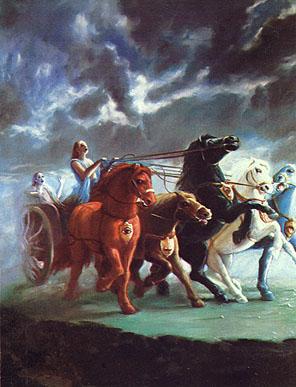
Each sacred chant seems to begin slow and steady and builds in intensity and speed, finishing with a thrilling "crash" of the  kartals, or "thump" on the mridanga. After a chant or two, the wallah opens the Bhagavad Gita and shares personal insights on their sacred Hindu text. "Consider the image of the person attempting to drive a carriage led by five wild horses," he explains, "These five horses represent our senses--taste, smell, sight, sound, and touch. Until we can tame and yoke those senses, we will always be out of control." And how can we learn to control those senses? This wallah mentions yoga, namely kirtan, which he calls "true yoga", to tame the horses and gain control of the carriage, to gain control of our mortal life journey. He says, "You can't be thinking about your hunger, your lust, your anger when you are caught up in the sacred chanting."


Five Horses - Arjuna and the Bhagavad Gita - Preview Image

Many believe that kirtan is the essence of yoga. Yoga means "to yoke". What are we trying to yoke? Five wild horses! We are striving to yoke the mind, body and spirit, not just to one another, but to God. Or could it be that a fully-yoked mind, body and spirit actually is God? Or are we possibly just making room for God to enter? Or are we finding that God was within us all along? Yes. Yes. And yes. God is within and without. He is cellular and cosmic. He is flesh and spirit.

Here is an example of a kirtan experience that rose up in the youtube world, because in case I forgot to mention it, above all else, kirtan is just really, really fun!


Monday, June 15, 2015

Child's Pose


Something lovely about the Bodhi Flow is that we take the time to revisit child's pose in every tier, though admittedly in the fourth tier we approach it from a slightly different angle. Dropping back and rolling the spine along the mat, our legs pull into our chests and for just a brief moment, there it is, a fetal-like position--child's pose. Leading a class today, halfway into tier three I heard myself say the words "Let's pull back into child's pose and take several full, restorative breaths." Perhaps why I heard (like, really heard) my own words so clearly was because I had said that same phrase each time we went into that pose without realizing it. How interesting, I thought, that I feel a need to say this aloud every time we visit this pose. Part of leading a yoga class, in my experience, is learning to trust what your own body is telling you, then letting that guide the movement for the class. My body really wanted those moments of restoration apparently. What is it about child's pose that invites the restorative breath, I silently wondered as we pushed back into downward facing dog.

Almost as soon as I asked the question awareness flooded over me. I've been revisiting some semblance of child's pose all of my life yearning for restoration, and long before I was ever practicing yoga. Just as there are tiers of the Bodhi Flow, there are certainly tiers or stages of life, all of which brings a different focus.

Intentions and focus of the Bodhi Flow tiers look like this:

Tier One- Warms the Body
Tier Two- Opens Flexibility
Tier Three- Builds Strength and Stamina
Tier Four- Reduces Tension and Balances Breath

I'm beginning to see how the intentions and focus of my own life change and evolve as I age. It's a marvel how much childhood varies from young-adulthood, and how adulthood varies from the elderly years. Yet, throughout it all, when we take the time to pull back, take some deep restorative breaths, and revisit "childhood"--that's when we find true restoration, isn't it?

www.gobodhiyoga.com

Saturday, June 6, 2015

Labyrinth Walk - say you'll follow me


It was dusk and I worried that maybe I'd not have enough time to fully experience it. But I'd been here once before and made similar excuses. Why was I so hesitant? I was so full of all the things this experience "should" be and all the things this labyrinth "ought" to do for me that there wouldn't be much room for the experience to just be what it was going to be. Am I going to blog about this? Won't taking pictures negate the sacredness? Will openly writing about it tarnish the spiritual nature? On and on and on went my analytical wanderings. I had confessed to Syl, my yogi mentor that created this mystical labyrinth in her backyard, my tendency to over-analyze. I told her I wanted to be free to walk the labyrinth without expectation. She chuckled and said something like, "No need to worry about that, the labyrinth is designed to challenge that very thing. You'll want to go one way and it'll take you exactly the opposite. Just don't fight it. It's not a maze where you have to choose a path. Trust where it takes you." So here at the entrance, I removed my shoes and did my yoga: Inhale, let it gather up all those "shoulds" and "oughts" and "have to-s", exhale. My walking prayer began.

There's something to be said about trust. I would find myself so close to the center, separated only by one little row of stones. The tall grass was tickling my skin as I brushed by it, closer than I'd ever been, until the path turned. One might think, I'm going the wrong way. Trust. No, this is good. Sometimes you have to have your back on the target, you know what I mean? Then, I'm walking along the perimeter, feeling so far away from it all. One sharp turn. I'm there. What? How can that be? Just moments ago I was...over there...I was...alone, drifting. So far, and yet so close.

Standing in the center, wanting to lift off the ground, I think I did. I didn't know that holding so much could feel so light.

It was time to step out. I stood at the exit, which had only moments before been the entrance. Now it was my turn to chuckle. You mean I have to come out the way I just came in? The answer settled upon me, "The path is the same, but you're different." So is the path really the same anymore? Hello paradox.
I was smiling and happy, taking my time with each step, winding my way out. First I was singing in my head. Soon I was humming. Then all at once I was singing out loud and proud:

"It's by far the hardest thing I've ever done
To be so in love with you and so alone

Follow me where I go, what I do, who I know
Make it part of you to be a part of me
Follow me up and down all the way and all around
Take my hand and say you'll follow me"


Where was this coming from? Why now, John? The words just kept coming:


"It's long been on my mind you know it's been a long, long time
I'll try to find the way that I can make you understand
The way I feel about you and just how much I need you
To be there where I can talk to you when there's no one else around

Follow me where I go what I do, who I know
Make it part of you to be a part of me
Follow me up and down all the way and all around
Take my hand and say you'll follow me"


And by this point, I said aloud, "I hear you!":


You see, I'd like to share my life with you and show you things I've seen
Places that I'm going to places where I've been
To have you there beside me and never be alone
And all the time that you're with me then we will be at home

Follow me where I go what I do, who I know
Make it part of you to be a part of me
Follow me up and down all the way...
Take my hand and I will follow you"

--John Denver, "Follow Me"


It was a mediocre experience. It was a sublime, ineffable experience. I suppose I'm leaning on Dickens a bit there. I mean to say that the act of walking the labyrinth in and of itself is a very simple, seemingly mindless activity (if you're willing to turn down the analyze slide bar). Yet, within that simple act, something truly miraculous opens up within you. I don't mean to ascribe too much "power" to the labyrinth itself. I don't see it as a magical panacea that absolves all worldly strife and takes you in a straight shot to nirvana. But in another sense, it's like this magical panacea that absolves all worldly strife and takes you in a straight shot to nirvana...at least for a little while. You get to taste it. And return to it as often as you'd like. It's as magical and mystical as prayer is, for the labyrinth is truly a walking prayer wheel. Prayer in and of itself is powerful, but match that with pure intention and that's when you achieve the sublime and ineffable.

P.S. Just for fun, click play below.