The first time, I'm ashamed to admit, that I ever heard the word "fontanelle" was when Edwina McDunnough in the film Raising Arizona says in her special drawl, "Now mind his li'l fontanelle!" I had only ever heard that little, vulnerable spot on a baby's head called a soft spot. But most things anatomical tend to have a more official name, and in this case the soft spot is officially known as the fontanelle. It seems Edwina McDunnough noughs more than her name implies!
Edwina McDunnough from Raising Arizona
But it wasn't until a few months ago that I learned that the word fontanelle is actually a French word that means "little fountain" or "little spring". Where is the correlation here? What does a baby's soft spot have to do with a fountain or spring? At this same time I was studying the nature of kundalini energy and discovering the winding path it travels up the chakras. This led me to Sahaja Yoga Meditation, founded by Shri Mataji Nirmala Devi. It was in reading her words that revealed to me for the first time the profound correlation between this seemingly inane label "fontanelle" and the experience of kundalini awakening. In her own words:
"Self-Realization is the awakening of the Kundalini through the central channel, as it pierces the six chakras above the sacrum bone and emerges at the top of the head (at the fontanel area) as a gentle "fountain" of coolness. (The word fontanel means "little fountain" which indicates again the ancient knowledge about this phenomenon of Self-Realization.)"
She even points out that it was the ancient Greeks who gave the sacrum its name, which means "sacred or holy bone"and is the medical term still used today. How beautiful that some truths weren't lost, only forgotten. The truth is often staring us in the face--or we're sitting on it, literally. Kundalini resides in the sacred triangular bone called the sacrum and achieves self-realization upon piercing through the fontanelle as a gentle fountain. Hmm. I have to hand it to the French and the ancient Greeks. Did they know the truth?
The group was small and most of us seemingly new to the whole experience, as evidenced by our coy reserve and inability to effectively sing along. But the few that were by all appearances "regulars" made the experience meaningful for the entire group. freeing our inhibitions and setting the tone. It's one thing to enjoy kirtan as an observer or listener and an entirely different thing to experience kirtan as an active participant. The experience comes to life when you feel the words and music burst out of your own mouth, even if, like me, you're half mumbling half singing the foreign tasting sanskrit words--no one cares how well you sing or how well you pronounce the words!
At the Radha Krishna Temple in Spanish Fork kirtan is an integral part of their Sunday worship service. Imagine you are there with me as the wallah (or kirtan leader) and other musicians are sitting cross-legged on a beautiful rug surrounded by their exotic instruments: the mridanga hand drums, the bell metal kartals and the harmonium, in this instance. The wallah, playing different instruments throughout the service, begins to play and chant then invites the congregation to join in, until everyone in the room is rocking back and forth, swaying, up and dancing and most certainly lending their voices to the chant.
Kirtan then....
...and now.
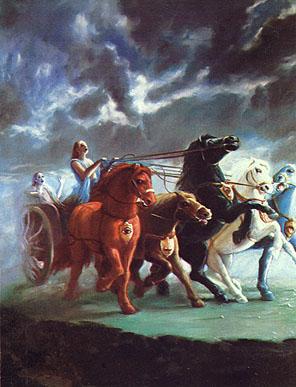
Each sacred chant seems to begin slow and steady and builds in intensity and speed, finishing with a thrilling "crash" of the kartals, or "thump" on the mridanga. After a chant or two, the wallah opens the Bhagavad Gita and shares personal insights on their sacred Hindu text. "Consider the image of the person attempting to drive a carriage led by five wild horses," he explains, "These five horses represent our senses--taste, smell, sight, sound, and touch. Until we can tame and yoke those senses, we will always be out of control." And how can we learn to control those senses? This wallah mentions yoga, namely kirtan, which he calls "true yoga", to tame the horses and gain control of the carriage, to gain control of our mortal life journey. He says, "You can't be thinking about your hunger, your lust, your anger when you are caught up in the sacred chanting."
Many believe that kirtan is the essence of yoga. Yoga means "to yoke". What are we trying to yoke? Five wild horses! We are striving to yoke the mind, body and spirit, not just to one another, but to God. Or could it be that a fully-yoked mind, body and spirit actually is God? Or are we possibly just making room for God to enter? Or are we finding that God was within us all along? Yes. Yes. And yes. God is within and without. He is cellular and cosmic. He is flesh and spirit.
Here is an example of a kirtan experience that rose up in the youtube world, because in case I forgot to mention it, above all else, kirtan is just really, really fun!
Something lovely about the Bodhi Flow is that we take the time to revisit child's pose in every tier, though admittedly in the fourth tier we approach it from a slightly different angle. Dropping back and rolling the spine along the mat, our legs pull into our chests and for just a brief moment, there it is, a fetal-like position--child's pose. Leading a class today, halfway into tier three I heard myself say the words "Let's pull back into child's pose and take several full, restorative breaths." Perhaps why I heard (like, really heard) my own words so clearly was because I had said that same phrase each time we went into that pose without realizing it. How interesting, I thought, that I feel a need to say this aloud every time we visit this pose. Part of leading a yoga class, in my experience, is learning to trust what your own body is telling you, then letting that guide the movement for the class. My body really wanted those moments of restoration apparently. What is it about child's pose that invites the restorative breath, I silently wondered as we pushed back into downward facing dog.
Almost as soon as I asked the question awareness flooded over me. I've been revisiting some semblance of child's pose all of my life yearning for restoration, and long before I was ever practicing yoga. Just as there are tiers of the Bodhi Flow, there are certainly tiers or stages of life, all of which brings a different focus.
Intentions and focus of the Bodhi Flow tiers look like this:
Tier One- Warms the Body
Tier Two- Opens Flexibility
Tier Three- Builds Strength and Stamina
Tier Four- Reduces Tension and Balances Breath
I'm beginning to see how the intentions and focus of my own life change and evolve as I age. It's a marvel how much childhood varies from young-adulthood, and how adulthood varies from the elderly years. Yet, throughout it all, when we take the time to pull back, take some deep restorative breaths, and revisit "childhood"--that's when we find true restoration, isn't it?